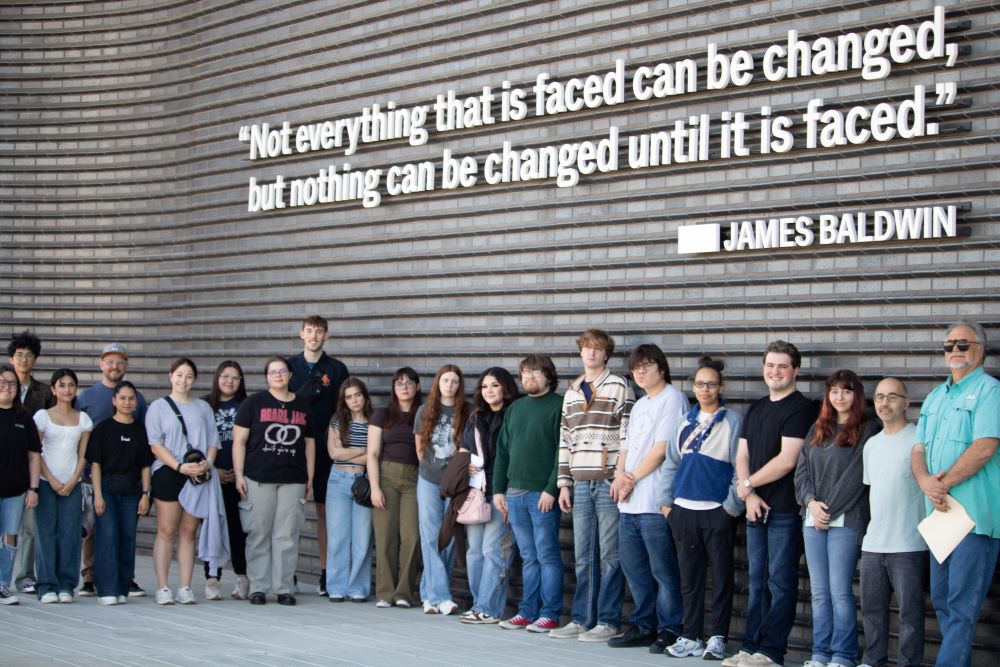
ADA, Okla. – East Central University students took part in a day trip to Tulsa, Okla. March 26, visiting the Greenwood Rising Black Wall St. History Center and the Woody Guthrie Center.
The group of 25 students, predominately from Dr. Ken Hada’s Humanities course, was comprised of English, English Education, Elementary Education, Psychology, Physics, Nursing and Computer Science majors, ranging from freshmen to seniors. It was primarily made up of Oklahoma natives, though several were international students attending ECU from Nepal. Despite the majority of the group’s connections to Oklahoma, the topic of each visit was unfamiliar to most.
“What most excited me about this trip was giving our students a multi-level cultural experience,” said ECU professor and co-sponsor for the trip, Dr. Joshua Grasso, “…going to Tulsa and experiencing the heart of a thriving city, experiencing a professional-level museum, and being immersed in a historical reality that only the combination of art and archival objects can produce.”
The Greenwood Rising visit began with a walk from the parking area to the museum itself, allowing students to view historic downtown Greenwood and seeing the successes of the modern businesses in the area.
Once inside the museum, the tour began with a short lecture about what to expect and how the narrative history of Greenwood is told through the exhibit.
Students then had the chance to tour at their own pace, beginning with the first hall, which featured information about the success and significance of Greenwood before the Tulsa Race Massacre and the aftermath.
The visit concluded with a reminder of the recovery and success of the Greenwood neighborhood and their dedication to educating the community on their history, a message that resounded with the students.
“Visiting Greenwood Rising was both emotional and eye-opening, and the story of loss and resilience weighed heavily on me,” said English major, Jayde Landreth. “The exhibit featuring survivors recounting that night fully immersed me in the horrors of the 1921 Tulsa Race Massacre, giving the past a voice and bringing first-hand stories to life.”
Following a lunch break at Mother Road Market, the students then visited the Woody Guthrie Center on Tulsa’s Reconciliation Way.
Similar to Greenwood Rising, the tour began with a speech from the museum’s guide, who spoke directly to the students, engaging them as he told the story of Woody Guthrie’s childhood and the environment that he grew up in in Okemah, Okla. He discussed how Guthrie’s career was defined by the oppression, persecution and hardships he witnessed and experienced as an Oklahoman during the Dust Bowl of the 1930’s.
Zachariah Hobia, an ECU English Major, stated, “I grew up 15 minutes from Okemah. So going through the Woody Guthrie Center made me feel very close to history. We were shown a film, and then let loose to explore the various things from his life and art; guitars, an exhibit about artists from the modern era he’d influenced and manuscripts of his lyrics. And through it all, I was thinking of how all this was from the life of a man who came from Okemah, a small town that I’ve known since I was young.”
Following the conclusion of the final tour, the students returned to campus with a new, firsthand understanding of both a historical neighborhood and historical figure from Oklahoma.
One student, Autumn Bloomer, stated, “Both Greenwood Rising and the Woody Guthrie Center shown the true spirit of Oklahoma: To challenge the narrative, love they neighbor, overcome struggles and continue to ‘Rise.’”
Isabelle Kirby, another member of the group, stated, “The [Greenwood Rising Center] was an eye-opening experience. Then to find out at the Woody Guthrie Center that he was so bothered by something that happened before [he was born] made him want to try and make a change in the world around him, even through the challenges he faced, was truly inspiring.”
The trip was made possible by the organization of Hada and by the James Harris Travel Fund. The fund provides support for faculty and students in the College of Liberal Arts and Social Sciences (CLASS) for the purpose of visiting important sites, conferences, and activities in their chosen professional fields. Faculty submit applications each fall and spring; a committee comprised of the department chairs in CLASS make selections based on the educational opportunities described in the proposal. Dr. James Harris was a prominent Professor of History at ECU in the 1970s-80s.
-ECU-